Jackery Explorer 240D review: this is a compact power station built around DC device charging, not a full household backup rig.
If you want portable power for travel, camping, and emergency essentials, it has a clear lane.
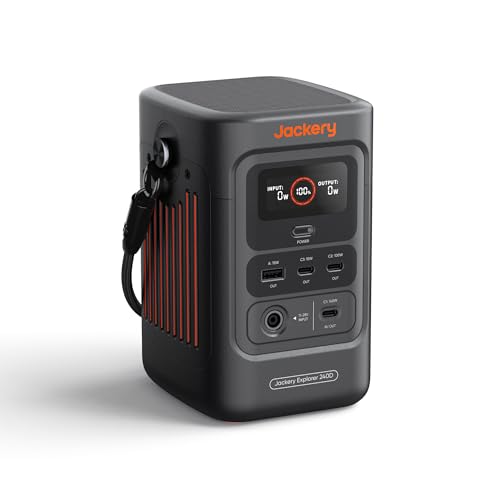
Explorer 240D Review Summary
The Jackery Explorer 240D makes sense for buyers who care more about portability and fast top-ups than wall-outlet output.
Its appeal is simple: 256Wh of capacity, 200W of pure DC output, four charging ports, and a LiFePO4 battery built for long service life.
That combination gives it a very specific value proposition.
It suits people who carry phones, tablets, cameras, lights, small USB-C devices, and other low-to-moderate power gear, especially when they want a lighter pack-in option for road trips or camping.
It is not the right choice if you need AC outlets or want to run heavier appliances.
Review Scorecard
| Category | Score | Rationale |
|---|---|---|
| Portability | 9/10 | Listed at about 4.9 pounds and designed to be compact for travel and outdoor carry. |
| Charging flexibility | 8/10 | Supports USB-C, solar, car charging, and AC-DC dual input. |
| Device output | 8/10 | 200W pure DC output with up to 140W per port covers many everyday devices. |
| Battery longevity | 9/10 | LiFePO4 chemistry and a claimed 10-year lifespan are strong durability signals. |
| Emergency usefulness | 7/10 | Good for essential electronics, but it is not a whole-home or AC-heavy solution. |
| Carry convenience | 8/10 | The included 2-in-1 USB-C strap cable adds practical grab-and-go utility. |
Key Features and Specifications of Explorer 240D
The Explorer 240D is positioned as a portable power station with a clear emphasis on DC output and mobility.
The listing calls out 256Wh of energy, four total ports, and support for powering up to four devices at once.
The port mix includes three USB-C ports and one USB-A port, which is useful if your gear already lives in the USB ecosystem.
The headline spec is the 200W pure DC output, with up to 140W per port.
For the right devices, that is the feature that matters most.
It should be viewed as a charging hub for modern portable electronics rather than a substitute for a larger inverter-based power station.
Other notable details:
- Weight is listed at about 4.85 to 4.9 pounds, which keeps it in the portable category.
- The dimensions are compact enough for backpacks, car kits, and camping bins.
- The battery is LiFePO4, which is the right chemistry if long cycle life matters to you.
- Jackery claims a 10-year lifespan and more than 6,000 cycles with substantial remaining capacity.
- The unit supports solar charging up to 100W.
- With the 100W charger and AC-DC dual input, Jackery says it can reach 80% in about one hour.
- The box includes a 2-in-1 USB-C strap cable that doubles as a carrying strap.
The strongest practical takeaway is that this product is designed for flexibility during movement.
It is compact, light, and geared toward frequent charging of personal electronics rather than occasional backup for large loads.
Pros and Cons of Explorer 240D
Pros
- Very portable for a power station: the listed weight makes it easier to carry than larger backup units.
- Modern USB-C focus: three USB-C ports fit current phones, tablets, and many accessories.
- LiFePO4 battery: better long-term fit than older lithium battery designs when longevity is a priority.
- Useful fast-charging options: dual input and 100W charger support improve turnaround time.
- Travel-friendly design: the included strap cable and small form factor fit mobile use.
Cons
- No AC output is highlighted in the supplied evidence: that limits what you can actually power.
- Capacity is modest: 256Wh is good for devices, not for sustained heavy use.
- Best for a narrow use case: buyers looking for appliance backup should look elsewhere.
- Pure DC design may not suit every user: some shoppers want the flexibility of an inverter-based station.
The overall profile is balanced, but only if your expectations match the product’s design.
Its strengths are real, but they are focused strengths.
Who Should Buy Explorer 240D?
Buy the Jackery Explorer 240D if you want a small, dependable portable charger for electronics and low-wattage gear.
It fits campers who mostly need phone and accessory power, travelers who want a car-friendly charging station, and households that want a compact emergency backup for essential devices.
It also makes sense for users who value battery longevity.
The LiFePO4 battery and 10-year lifespan claim are meaningful if you plan to keep the unit in rotation rather than replace it quickly.
Skip it if you want to run AC appliances, coffee makers, kitchen gear, or anything that depends on a larger inverter-style output.
If your goal is whole-home backup or a campsite power hub for bigger loads, this is too limited.
Charging and Portability Tradeoffs of Explorer 240D
USB-C First, Not Appliance First
The port lineup tells you almost everything about the product’s intent.
Three USB-C ports and one USB-A port make it useful for modern electronics, but the evidence provided points to DC-centric use, not broader appliance support.
Built for Easy Carry
At roughly 4.9 pounds, the Explorer 240D is easy to move between a desk, car, campsite, or emergency shelf.
That matters because a power station only helps if you are willing to bring it with you.
Fast Refill Options
The available charging paths are one of the main reasons to consider it.
Solar, car, USB-C, and AC-DC dual input give you flexibility, and the one-hour claim to 80% with the 100W charger is appealing for quick turnarounds.
Long-Life Battery Planning
LiFePO4 is the right call for buyers who care about durability.
A battery designed for many cycles changes the ownership equation, especially if you expect regular use during travel seasons or recurring outages.
Alternatives to Explorer 240D
If you need a broader inverter-style power station, consider the Anker SOLIX C300, which is often a more flexible category match for shoppers who want a small portable station with wider power ambitions.
If you want a familiar compact option from the same brand family, look at the Jackery Explorer 300 Plus, which may suit buyers comparing Jackery’s smaller portable lineup.
For shoppers who prioritize a more established portable power-station format, the BLUETTI AC2A is another credible comparison point.
Is Explorer 240D Worth It?
Yes, if you want a compact Jackery power station for device charging, travel, and emergency essentials.
The Explorer 240D is worth it for buyers who understand that its value comes from portability, LiFePO4 longevity, and modern USB-C centered output.
No, if you need AC appliance support or a more general-purpose backup solution.
For the right buyer, it is a smart, focused purchase; for everyone else, it is too specialized.